Photography talk , post up your images.

ktnez99

Zorg Guru (IV)
British Zeds
Joined
May 18, 2018
Points
164
Location
West Midlands
Model of Z
Z3 2.8L
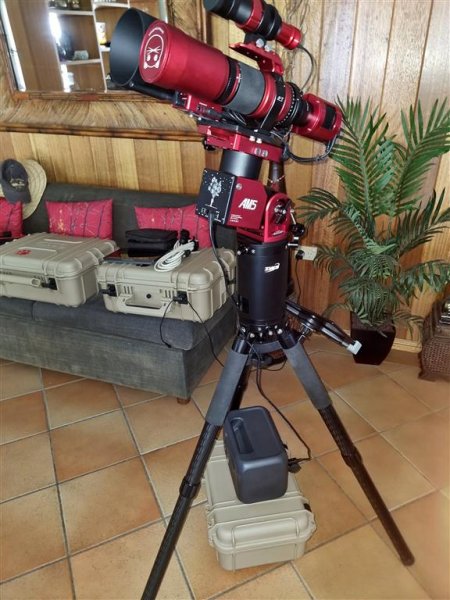
Some new gear, that will guarantee cloudy nights for the next month or so...Just a clip on to the existing rig.. Its that little tiny telescope nearest with its own little camera on the back..now that talks to the tiny computer on top and instructs the mount to make tiny corrections to tracking by watching the field of view for any deviation, whilst the main scope and camera collect the images..theory is I should be able to go well past 60 seconds per frame.. When the clouds clear...:whistle:. Just thought you might find it interesting.. If I get stellar results, Ill post em up. If I don't you will hear no more of it...=))

View attachment 301091
This needs serious support. How heavy is it? What tripod do you use?!?
 

ExMX5owner

Administrator
Staff member
Global Moderator
Supporter
Australian Zeds
Joined
Aug 31, 2022
Points
139
Location
Queensland, Australia
Model of Z
99 2.0
This needs serious support. How heavy is it? What tripod do you use?!?
Its been upgraded a bit since I took that one, It now looks like this.. Carbon fibre tripod, the whole rig is about 18kg, fits in those three cases for easy transport to dark skies.
 

Attachments

ExMX5owner

Administrator
Staff member
Global Moderator
Supporter
Australian Zeds
Joined
Aug 31, 2022
Points
139
Location
Queensland, Australia
Model of Z
99 2.0
Do you have to watch out for alligators or crocodiles?
Not that far inland, snakes maybe. and these little guys.. :whistle:.
One of our favorite spots, great wildlife, good skies, and at only about 300k away.

DSCN7782.JPG
 

Eddie Zedder

Zorg Guru (III)
Supporter
British Zeds
Joined
Jun 10, 2015
Points
148
Location
Megawatt Valley, Notts.
Model of Z
Z3 2.0
After waiting weeks for clear skies, Saturday night thankfully produced the goods, not one but two comets. Up first C2025 A6 (LEMMON) followed by C2025 R2 (SWAN)
1761417573350~2.jpg
1761424043125~2.jpg
 

ExMX5owner

Administrator
Staff member
Global Moderator
Supporter
Australian Zeds
Joined
Aug 31, 2022
Points
139
Location
Queensland, Australia
Model of Z
99 2.0
After waiting weeks for clear skies, Saturday night thankfully produced the goods, not one but two comets. Up first C2025 A6 (LEMMON) followed by C2025
Upgraded my kit and looking forward to some clear skies...:thumbsup:. Dual Asiairs and dual cool cameras...
20251107_083622 (Medium).jpg

20251107_083634 (Medium).jpg
 

ExMX5owner

Administrator
Staff member
Global Moderator
Supporter
Australian Zeds
Joined
Aug 31, 2022
Points
139
Location
Queensland, Australia
Model of Z
99 2.0
First Image off the new scope..
(M57), a planetary nebula in the constellation Lyra, about 2,000 light-years away. It is the glowing gas expelled from a dying star that has collapsed into a white dwarf.
It shows promise, this little scope..

1763949455658Edit_jpeg_38e6b892-5150-4ac6-813b-ed20bf5b4e8b.jpg
 

GZed

Zorg Guru (I)
British Zeds
Joined
Jun 28, 2018
Points
95
Location
Shrewsbury, Shropshire
Model of Z
Z3 2.8 Prefacelift
First Image off the new scope..
(M57), a planetary nebula in the constellation Lyra, about 2,000 light-years away. It is the glowing gas expelled from a dying star that has collapsed into a white dwarf.
It shows promise, this little scope..

View attachment 353499
Amazing picture! According to Google 2000 light years is 11,760 TRILLION miles away. Not Million, not Billion- but TRILLION. Mind blowing🤪
 

ExMX5owner

Administrator
Staff member
Global Moderator
Supporter
Australian Zeds
Joined
Aug 31, 2022
Points
139
Location
Queensland, Australia
Model of Z
99 2.0
Amazing picture! According to Google 2000 light years is 11,760 TRILLION miles away. Not Million, not Billion- but TRILLION. Mind blowing🤪
Its mind blowing for sure, the scope is a mak, the definition of which is here.

A Maksutov-Cassegrain (or "Mak") is
a highly compact, powerful type of catadioptric (mirror-lens) telescope that uses a spherical primary mirror, a spherical secondary mirror, and a strong negative meniscus corrector lens to fold the light path, resulting in long focal lengths in a short tube

It suffers from rather bad vignetting, so Ill have to take dark flats to remove it, but generally, its still portable and it shows promise..:thumbsup::thumbsup:
 

ExMX5owner

Administrator
Staff member
Global Moderator
Supporter
Australian Zeds
Joined
Aug 31, 2022
Points
139
Location
Queensland, Australia
Model of Z
99 2.0
Amazing picture! According to Google 2000 light years is 11,760 TRILLION miles away. Not Million, not Billion- but TRILLION. Mind blowing🤪
How about this one then, It needed another hour at least, but it was already 4 in the morning, Ill get back to this target and add to it over time at this focal length.. but I have to sleep occasionally. When converting distance from light years to kms, careful to count the zeros before the decimal point ;)

The Andromeda Galaxy (M31) is our closest large spiral galaxy neighbor, visible as a faint smudge in the night sky from dark locations, located about 2.5 million light-years away in the constellation Andromeda. It's similar in size to the Milky Way, contains a trillion stars, and is on a collision course with our galaxy, predicted to merge in about 4.5 billion years to form a giant elliptical galaxy.

1763848127580Edit_jpeg_83458896-7e6d-4343-9ea0-9994cd7364da.jpg
 

ExMX5owner

Administrator
Staff member
Global Moderator
Supporter
Australian Zeds
Joined
Aug 31, 2022
Points
139
Location
Queensland, Australia
Model of Z
99 2.0
My new little scope..
I did identify one of the big issues with little scope, that being internal reflection inside the tube behind the corrector plate, so it took surgery to fix it, remove corrector and apply flock to inside of tube, replace corrector exactly where it was. the result is nothing short of astounding.
I have attached the flats, and here is an AI snippet of what flats are, if your interested.

In astrophotography,
flats (or flat field frames) are calibration images used to correct uneven illumination and optical path imperfections in your final image. They are essential for removing "dust donuts" (shadows from dust on the sensor or filters) and vignetting (the darkening of image edges).


Key Purposes of Flat Frames

  • Correcting Vignetting: Evenly distributes light across the frame to eliminate darker corners caused by the telescope's optical design.
  • Removing Dust Artifacts: Subtracts shadows cast by dust particles on the sensor, filters, or lenses.
  • Normalizing Sensor Response: Accounts for small variations in sensitivity between individual pixels (Pixel Response Non-Uniformity or PRNU).
My images should improve, when I get to see the sky again.
Before Modification top, after modification bottom.
Master flat.jpg
Master flat flocked tube.jpg
 
Last edited:
Top